An end-to-end customer churn prediction pipeline. Uses Python (Scikit-Learn) and Logistic Regression to train the prediction model, calculate ROC curves, and evaluate feature importance. Uses a high-performance Go CLI to ingest the risk scores and build daily action lists for the retention team.
Un pipeline de extremo a extremo para la prediccion de fuga de clientes. Utiliza Python (Scikit-Learn) y Regresion Logistica para entrenar el modelo, calcular curvas ROC y evaluar factores de riesgo. Utiliza una veloz herramienta CLI en Go para leer los puntajes de riesgo y generar listas diarias de accion para retencion.
| Language | Component | Libraries/Frameworks |
|---|---|---|
| Python | Model training, Evaluation, Visualizations | pandas, numpy, scikit-learn, matplotlib |
| Go | High-speed Retentional Action CLI | stdlib only (Zero dependencies) |
The Logistic Regression model was trained on a synthetic telecom dataset of 2,500 customers.
- Base Churn Rate: 12.4%
- Model AUC-ROC: 0.8883 (Excellent predictive ability)
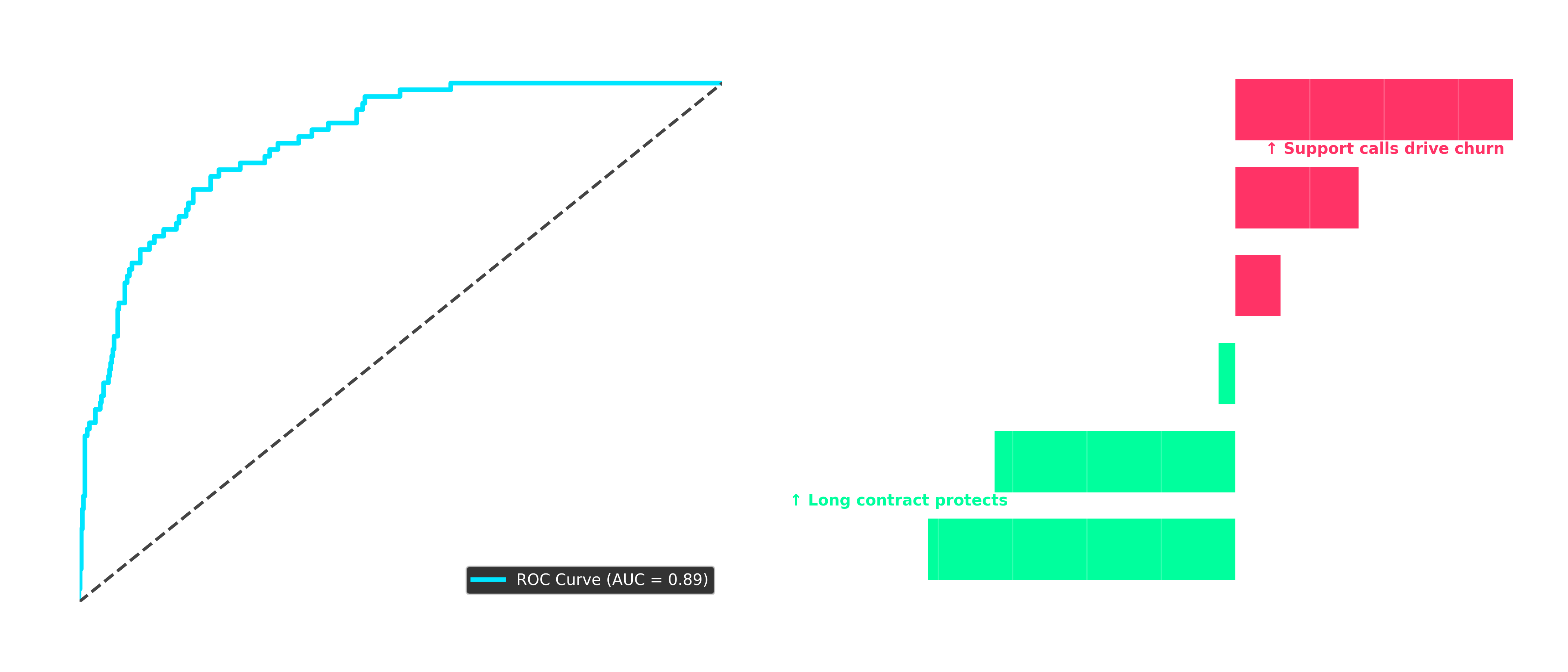
Business Insights:
- Increased support calls are the strongest warning sign of impending churn.
- Customers on longer contracts (1-2 years) are highly protected against churn.
Insights de Negocio:
- El incremento en llamadas a soporte es la mayor señal de advertencia de fuga.
- Los clientes con contratos largos tienen alta proteccion contra la fuga.
Generates the synthetic dataset, trains the ML model, and outputs the churn_predictions.csv file for Go to consume.
pip install pandas numpy scikit-learn matplotlib

python python/01_churn_model.pyReads the output probabilities and generates a targeted list of actions based on risk threshold.
cd go

# Default run (Outputs Top 15 users with Risk > 70%)
go run retention_cli.go -file ../data/churn_predictions.csv

# Custom Filter (Outputs Top 50 users with Risk > 85%)
go run retention_cli.go -file ../data/churn_predictions.csv -threshold 0.85 -limit 50
CLI Example Output / Salida de Ejemplo del CLI:
DAILY RETENTION ACTION LIST
Model Threshold: > 85% Risk Probability
Total Customers Analyzed: 2500

CUSTOMER ID     TENURE (mo)  SUPPORT CALLS  RISK PROB    RECOMMENDATION
----------------------------------------------------------------------------
TEL-1108        3            7              99.4%        Agent Call ASAP
TEL-0082        8            6              99.2%        Agent Call ASAP
TEL-1587        1            5              98.9%        Onboarding Flow
TEL-1381        34           4              86.7%        Offer 10% Discount
----------------------------------------------------------------------------
Found 115 customers needing immediate retention action.
Julian David Urrego Lancheros Data Analyst · Python Developer · Marketing Science GitHub · juliandavidurrego2011@gmail.com