AI Coding Enters the "Agent Teamwork" Era: Introducing Qoder Experts Mode

desc: "Beyond coding—toward delivery. AI is evolving from a "programmer" into an "engineering expert team.""
category: Product
img: "https://img.alicdn.com/imgextra/i4/O1CN01g7OIQo1iF0gkhXT7m_!!6000000004382-2-tps-1712-1152.png"
time: March 18, 2026 · 8min read
As AI Coding continues to accelerate its real-world adoption, developer expectations are fundamentally shifting.
We no longer settle for an AI that handles isolated code segments and executes tasks sequentially. Truly complex engineering tasks extend far beyond "writing a piece of code"—they require planning, implementation, debugging, and verification across multiple phases, spanning files, modules, and even entire systems.
A single Agent executing tasks sequentially is not only slow but also prone to losing direction within complex engineering contexts.
Real engineering delivery has never been a solo endeavor.
This marks AI Coding's transition to its next phase: From Agentic Coding to Agentic Engineering.
Experts Mode: Your AI Engineering Expert Team
Experts Mode is Qoder's multi-agent collaboration capability designed for complex development tasks. Users simply describe their requirements, and the system automatically breaks down tasks, assembles an expert team, and executes solution design, code implementation, and verification in parallel—delivering production-ready engineering outcomes.
This is not simply duplicating Agents to run in parallel. It is a precisely orchestrated team of domain specialists—with clear division of responsibilities, coordinated collaboration, and closed-loop quality assurance.
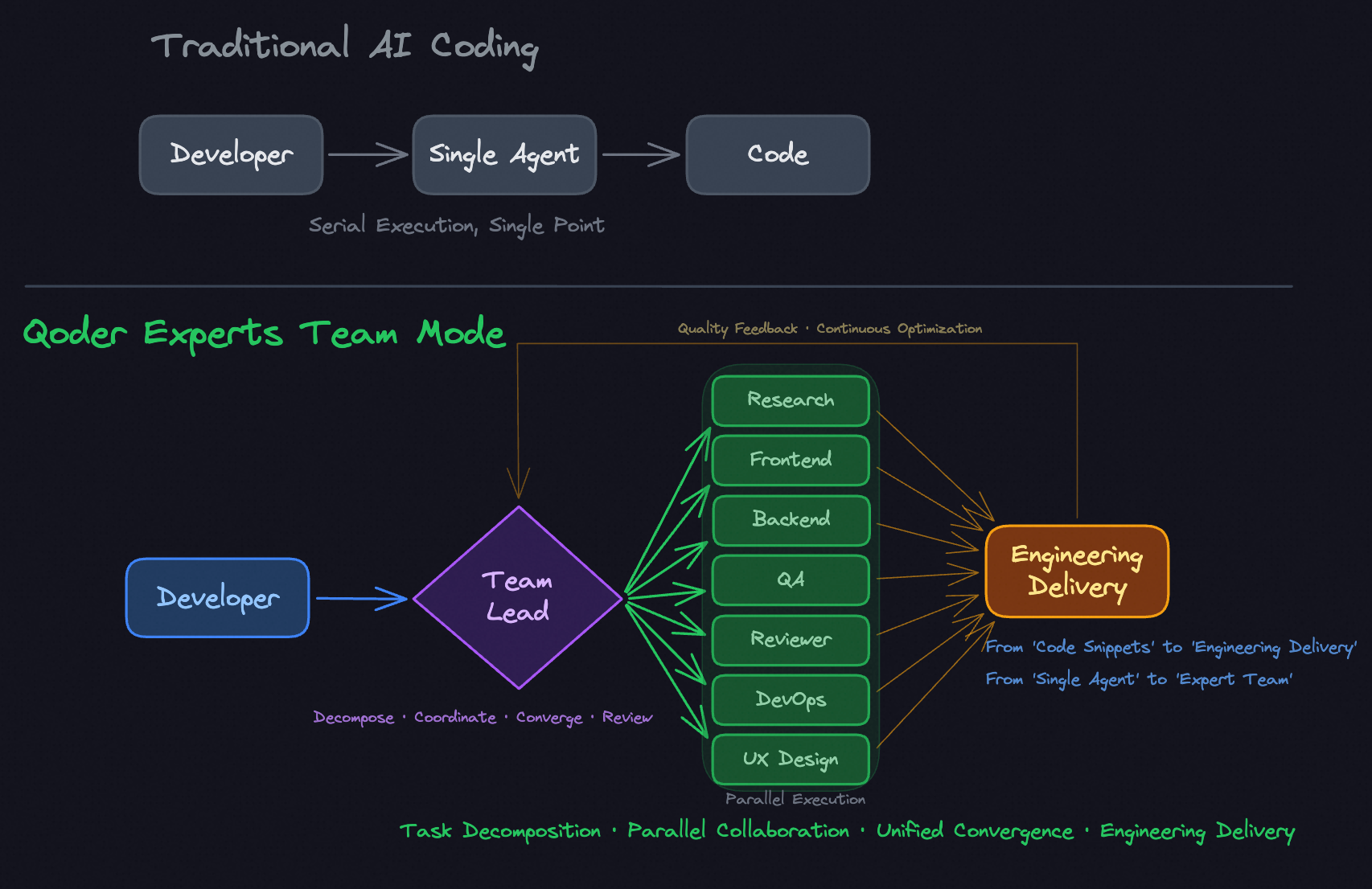
To see how this works in practice, let’s walk through a real example.
What Makes Experts Mode Different
1. Parallel Collaboration: A Team of Specialists
Traditional AI Coding is constrained by the single-Agent model: one model, one prompt, sequential execution through every phase. As task chains grow longer, context overload leads to compounding errors and slowdowns.
Experts Mode works differently. After the Team Lead decomposes the task, five domain specialists—Team Lead, Frontend, Backend, QA, Reviewer, and etc.—take over in parallel, each focused on what they do best.
What sets this apart is how each expert is configured for their role:
- Best-fit Models: Each expert runs on the model best suited to their task type, whether that demands stronger reasoning, faster inference, or domain-specific capability.
- Dedicated System Prompts: Role awareness and professional boundaries are reinforced at the prompt level, keeping each expert focused and on-domain.
- Contextual Tool Sets: Each expert only has access to the tools most effective for their specific function, reducing noise and improving precision.
This specialization reduces context switching and redundant inference, producing faster, more accurate, and more reliable outputs than any single Agent can achieve.
You stay in control throughout. Ask follow-up questions or adjust direction at any point—the Team Lead routes your input to the right expert at the right moment.
2. Continuous Self-evolution: An AI Team That Grows with You
Most AI tools complete tasks and retain nothing. Every new requirement starts from scratch, even when the problem is familiar.
Experts Mode is designed to grow with you:
- Expert Skill (Individual Evolution): Each expert learns your tech stack and preferences through repeated collaboration—getting sharper with every task.
- Team Skill (Team Evolution): The system tracks which expert configurations work best for which task types, and automatically applies that experience next time.
You are not using an AI—you are working with a team that remembers, learns, and grows stronger with each engagement.
3. Closed-Loop Delivery: From "Generating Code" to "Completing Tasks"
Generating code is only part of the job. Real engineering delivery means: requirements decomposed correctly, solution actually executable, multi-module work progressing in coordination, tests covering critical edge cases, output ready for review and merge.
Most AI tools handle the code generation step. They struggle with everything around it.
Experts Mode is designed around the outcome, not the output.
From task planning and role assignment through implementation, testing, and review—the entire engineering workflow runs as a closed loop. What you receive isn't just code. It's a deliverable that has been planned, built, tested, and reviewed.
Performance Evaluation Data
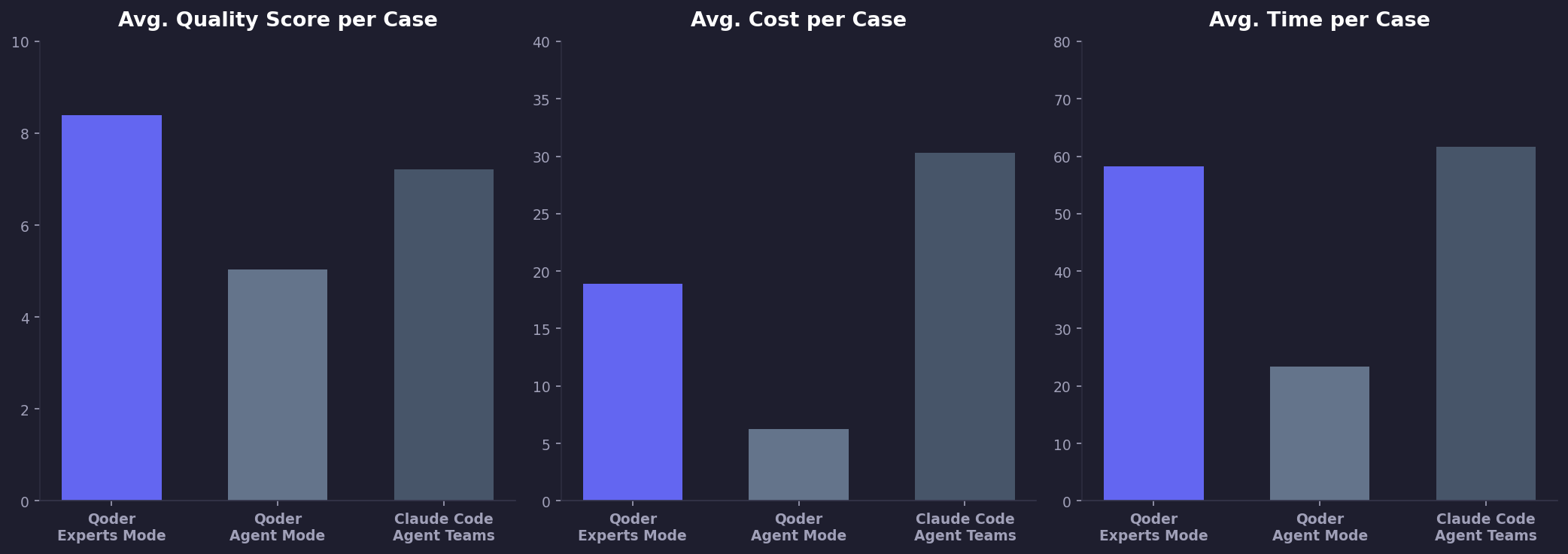
We conducted systematic evaluation of Experts Mode using our internal complex task benchmark suite. Testing covered multiple representative engineering scenarios, including full-stack frontend-backend development, large-scale cross-language refactoring, and complete feature implementation on existing codebases.
Key Findings:
- Significant Quality Improvement: Experts Mode scored 67% higher than Agent Mode and 16% higher than Claude Code Agent Teams. For complex tasks, the quality benefits of multi-expert collaboration are substantial.
- Optimal Cost-Effectiveness: Delivers higher-quality results at less than two-thirds the cost of Claude Code Agent Teams.
- Efficiency and Quality Combined: Execution time is comparable to Claude Code Agent Teams, with superior delivery quality. Compared to Agent Mode, single-execution time increases slightly; however, more thorough planning and comprehensive testing significantly reduce rework and iterative corrections. Overall, the total cycle from requirement to final deliverable is actually shorter.
Data sourced from Qoder's internal complex task benchmarks. All tests used identical models, with costs calculated using official API pricing.
Recommended Use Cases for Experts Mode
Experts Mode is designed for medium-to-large engineering tasks—it delivers maximum value when end-to-end, high-quality results are expected in a single execution. The following represent three typical scenarios:
1. Full-Stack Development
Requirement: Develop a user management module including registration, login, profile display, and profile editing functionality.
The Team Lead generates the technical plan, frontend and backend experts develop in parallel, the QA expert simultaneously writes tests, and the review expert ensures quality standards. Development that previously required several days can now be delivered in hours.
2. Complex Issue Diagnosis and Resolution
Scenario: A production performance bottleneck emerges, with logs indicating involvement across Order, User, and Payment microservices.
The Team Lead assembles backend and operations experts to collaboratively analyze logs, trace call chains, locate the bottleneck, generate a remediation plan, and verify the fix. Transform exhaustive debugging into precise, surgical resolution.
3. Technical Solution Research
Task: Evaluate the feasibility of adopting GraphQL to replace RESTful APIs for a new project.
Research experts gather technical documentation while frontend and backend experts assess the impact on the existing technology stack from their respective perspectives. A comprehensive, actionable technical research report is delivered rapidly.
For simple, well-defined file modifications, Agent Mode remains the more efficient choice. Selecting the appropriate tool maximizes effectiveness.
Get Started
Experts Mode is now available.
Your AI expert team, ready to build alongside you.
Experts Mode represents the formal transition from single-agent orchestration to the era of multi-agent collaboration.
The AI of the future is not merely a programmer—it is an expert team that stands ready, continuously evolves, and truly understands engineering.
This is a beginning. True intelligence emerges through collaboration.